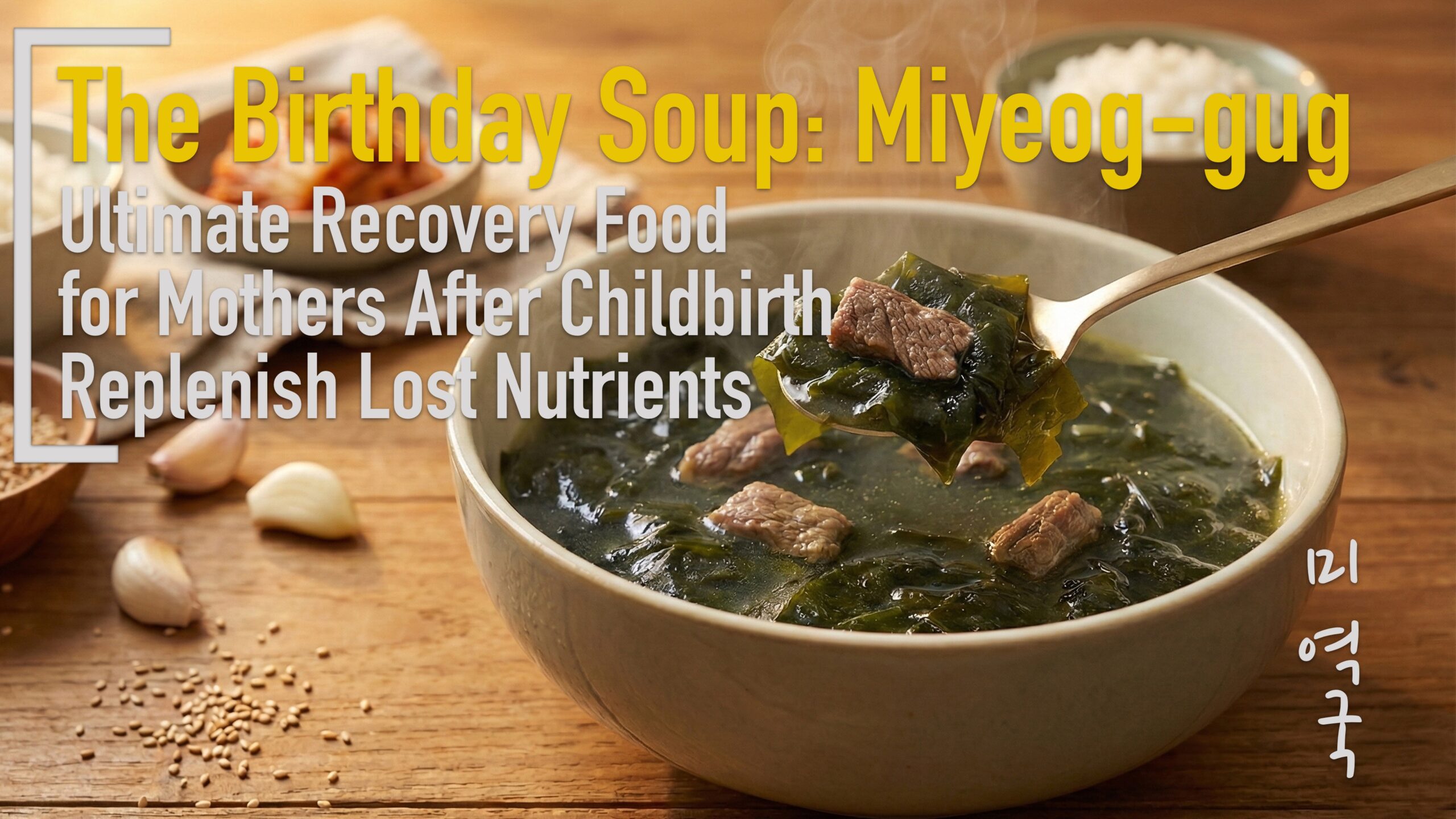
Holy Trinity of Miyeog-gug: Korean Seaweed Soup
Miyeog-gug is a nutritional powerhouse, packed with iodine for thyroid health, calcium for strong bones, and iron to prevent anemia. It helps with detoxification due to its soluble fibers and is culturally revered as the ultimate recovery food for mothers after childbirth (Sanhujori) to replenish lost nutrients.
Let’s dive into the Nutritional Science! Think of Miyeog not just as a sea vegetable, but as a “multivitamin from the ocean.”
Nutritional Science
It is famous for three powerhouse nutrients, often called the “Holy Trinity” of Miyeok-gug:
- Iodine (The Thyroid Fuel):
-
- What it does: Your thyroid gland is like the engine of your body, controlling how fast you burn energy. Iodine is the fuel for that engine.
- Benefit: Brown seaweed has one of the highest iodine contents of any food, which helps regulate your metabolism and energy levels.
- Iron (The Blood Builder):
-
- What it does: Iron is a key component of hemoglobin, which acts like a “delivery truck” carrying oxygen in your blood to all your cells.
- Benefit: This is why it’s crucial for preventing anemia and keeping your energy up, especially if you’ve lost blood (which hints at why it’s a postpartum staple!).
- Calcium (The Bone Booster):
-
- What it does: We usually think of milk for calcium, but seaweed is a surprising plant-based source!
- Benefit: It strengthens bones and helps muscles function properly.
Analogy Time: Imagine your body is a construction site.
- Calcium is the steel beams keeping the structure (bones) standing.
- Iron is the workforce transporting materials (oxygen) everywhere.
- Iodine is the electricity keeping the machinery (metabolism) running.
If someone were feeling constantly tired and sluggish due to a “slow engine” (low metabolism), which nutrient in Miyeok-guk would be most helpful for them? Spot on! Iodine is indeed the key fuel for your thyroid to regulate metabolism.
The “Slippery” Secret: Detoxification
Now, let’s move to the second part of the nutritional science: the texture.
If you’ve ever touched soaked seaweed, you know it’s slippery and a bit slimy. That slime isn’t just there to feel funny—it’s actually a superpower called Alginate (Alginic Acid).
Here is how it works as a “Detox” agent:
- The “Sticky Magnet” Effect: Alginate is a sticky, soluble fiber. Because your body doesn’t digest it fully, it moves through your intestines like a sticky lint roller.
- Heavy Metal Trapper: As it travels, it binds to heavy metals, radioactive elements, and environmental toxins (like fine dust) in your digestive tract.
- The Exit Strategy: Instead of letting those toxins get absorbed into your blood, the alginate holds onto them and escorts them out of your body when you go to the bathroom.
This is why many Koreans eat Miyeog-gug or seaweed salads during the “Yellow Dust” season in spring—to help clear their bodies of inhaled pollutants!
The Whale’s Secret
You might be wondering, “Who figured out that slippery sea grass was good for new moms?”
Believe it or not, the legend starts with whales. According to ancient Korean records (like the Goryeo Dogyeong), people observed that after a female whale gave birth, she would immediately seek out beds of seaweed and devour it to regain her strength. The ancestors thought, “If it works for a giant whale recovering from birth, it must be good for humans too!”
So, Miyeog-gug became the very first meal a Korean woman eats after giving birth. It is the cornerstone of Sanhujori(postpartum care).
Why it’s the Ultimate “Mom Food”
It turns out the ancestors were scientifically spot on. Here is exactly why Miyeog-gug is the perfect postpartum recovery food:
- Liquid Gold (Hydration & Milk): Breastfeeding requires a lot of water. Since Miyeog-gug is a soup, it provides essential hydration. Plus, the iodine we talked about earlier is secreted into breast milk, helping the baby’s brain development!
- Uterine Recovery: The calcium helps with muscle contraction (which the uterus needs to do to shrink back to size), and the iron replenishes the blood lost during delivery.
- Easy Digestion: After surgery or extreme physical exertion (like birth), digestion slows down. The soft seaweed and warm broth are gentle on the stomach compared to heavy, greasy foods.
Fun Fact: In Korea, a new mother might eat this soup for breakfast, lunch, and dinner for several weeks! It is affectionately (or sometimes dreadfully) known as the “Soup of Suffering” or “Soup of Love” depending on how sick of it she gets!
The “Birthday Soup”
In many Western cultures, you might celebrate a birthday with cake. In Korea, you celebrate with Miyeog-gug, seaweed soup.
But here is the beautiful twist: You don’t just eat it because it’s tasty. You eat it to honor your mother.
Because your mother ate this soup for weeks after giving birth to you, eating it on your birthday is a way of saying:“Mom, I remember the pain you went through to bring me into this world, and I am grateful for your care.”
So, even though it’s your birthday, the soup is a symbolic tribute to her sacrifice. It connects your birth day back to her recovery days.
When to AVOID Miyeok-guk (The Superstition)
While it’s great for birthdays, there is one day a Korean student would run away from this soup: Exam Day!
Remember the Alginate (the slippery slime) we talked about earlier?
- Scientific view: Slippery = Good for detox.
- Superstitious view: Slippery = Bad for grades!
In Korea, the phrase for “failing an exam” is often associated with “slipping” or “falling” (mikkeureojida).
The superstition says: “If you eat slippery seaweed soup before a test, all the knowledge you studied will slip right out of your head!”
Instead, students eat sticky rice cakes (called Chapssal-tteok or Yeot) so that the answers will “stick” to their brains!
The Chemistry of the Broth
If you simply boil seaweed in water, you get a clear, greenish tea. But a proper Miyeog-gug has a rich, slightly opaque or milky broth.
Where does that depth come from? It’s all about Lipids (Fats) and Emulsification.
Here is the secret scientific formula for the perfect soup:
- The Sauté (Maillard Reaction): You don’t just dump ingredients in water. First, you sauté the soaked seaweed and beef (or mussels) in Sesame Oil.
-
- This browns the meat (flavor!) and coats the seaweed in fragrant oil.
- The Emulsification (Making it Milky): When you add water and boil it vigorously, the agitation mixes the sesame oil and beef fat into the water.
-
- The seaweed acts as a stabilizer.
- The oil breaks into tiny droplets suspended in the water, turning the broth slightly cloudy/milky and creating a silky mouthfeel.
- The Savory Bomb: Miyeog is naturally high in glutamate (the molecule that tastes savory). Combined with the beef and usually a splash of soup soy sauce (Gug-ganjang) or fish sauce, you get a flavor explosion without needing artificial stock cubes.
Ingredients:
- lean beef – 120g
- dried seaweed – 40g
- minced garlic – 3 cubes
- soup soy sauce – 2 tsp
- roasted sesame seed oil – 1 tbs
- olive oil 1 tbs
- water – 3 cups
Prep & Cooking:
- Prep:
-
- soak dried seaweed in water for 15-20 minutes
- thinly slice beef and marinate with garlic and soup sauce
- Cooking:
- Add olive oil in a small pot
- Drain water from soaked seaweed
- Sauté seaweed in olive oil, in medium heat, until seaweed becomes light brown TIP> Do not skip the step. This is where savory flavor is developed.
- Add marinated beef and sauté until light brown
- Add water and sesame oil
- Cut the seaweed in to bite sizes
- Bring to boil and cook for 30 minutes in medium low heat
- Add additional water as necessary
- Add salt to taste